
View all blog posts here or browse by category:

5 Astonishing Things That Happen When We Seek God
Seeking God isn’t a game. It’s a decision on our part that affects the trajectory of our lives on a daily basis. The Lord knows the beginning and the end. He has…
Some of the links in this post are affiliate links. That means if you click the link and make a purchase, I receive a small commission. As an Amazon Associate I earn from qualifying purchases. This is at no extra cost to you, but it helps me to further serve you in your walk with the Lord!
…6, 5, 4, 3, 2, 1…ready or not, here I come!
Didn’t you love a good game of Hide and Seek when you were a kid? I know I did. I remember liking the hiding part much better than being the seeker, however. Seeking was more difficult, took more time, energy, and wits— especially if I was up against good hiders. And, each game seemed to have its equal share of skillful hiders, and poor hiders.
The thrill of the game always came when everyone was found. No one wanted to be found, of course, but the seeker always did all he or she could to find the hiders. As a seeker, you couldn’t hold back or give up– otherwise, you’d be left wandering around for quite some time!
I recently heard someone share a memory of a time she played hide and seek with some sports teammates. A good game turned sour as she, the seeker, was left alone outside for over an hour because unbeknownst to her, the hiders had decided to forsake the game and go inside to watch TV.
Despite her best efforts and her persistence, she didn’t find the hiders because they were no longer hiding; they did not want to be found. Even though she tried her hardest, they didn’t care whether she found them or not.
Sister– this is not our God.
God calls us to seek Him, but He isn’t hiding. He doesn’t call us to come and find Him, yet change locations or change the rules of the game. He wants nothing more than to be found by His beloved.

The Importance of Seeking God
Seeking God isn’t a game. It’s a decision on our part that affects the trajectory of our lives on a daily basis. The Lord knows the beginning and the end. He has the strength, knowledge, and power that we do not.
When we seek God, we’re able to fully tap into the wisdom and power that He so freely wants to display through us. When we choose to do things on our own, we easily fail; or worse– we succeed, but He gets none of the glory.
One thing we can clearly see when studying the Bible is that there are those who seek God, rely on Him, and do right in the eyes of the Lord; and, there are those who don’t. But, more deeply relatable than that are the countless biblical figures who lived their lives as a mix of both– sometimes seeking, sometimes neglecting.
I think we all fall somewhere along those lines, right, sister?
One such person is Asa. The account of his story that I’ll reference can be found in 2 Chronicles 14-16. Before diving into the rest of this article, I’d encourage you to open your Bible and read it so you can follow along with my observations.
What Happens When We Seek God?
Asa was king over the southern kingdom of Israel, namely, Judah. He was Solomon’s great-grandson. 2 Chronicles 14:2 and 1 Kings 15:11 says he did right in the sight of the Lord. As we’ll see, Asa spent many years of his reign seeking God.
The Bible promises that when we seek God with all of our hearts and souls, we will find Him (Deuteronomy 4:29).
So, what does finding Him look like?
Looking through the lens of King Asa’s reign, here are a few things that happen when we seek God:
#1: We live righteously. (2 Chronicles 14:3-5)
Seeking God puts us in a position to have a strong desire to do what is right, removing the things from our lives that the Lord hates. We pursue righteousness. We see that Asa removed the altars, pillars, and anything leading to the worship of idols. His heart was devoted to the Lord, and he wanted his people to do the same.
When we seek God, we desire to honor Him in our actions. Not only did Asa remove the places of idol worship, but he also restored the altar of the Lord (2 Chronicles 15:8) and commanded the people of Judah to keep the law and seek God (2 Chronicles 14:4).
RELATED: HOW TO PURSUE RIGHTEOUSNESS
#2: We encourage others to seek God. (2 Chronicles 14:4)
When our heart is rightly turned towards and devoted to the Lord, we desire for those in our midst to do the same. Seeking God allows us to see more clearly His majesty, wisdom, and faithfulness. How could we not want others to experience these things as well?
Asa knew that seeking God was in the people’s best interest. Keeping the law wasn’t a way to punish them; it was God’s way of protecting them.
#3: The Lord gives us rest. (2 Chronicles 14:6-7)
Chapter 14 verse 7 tells us that because the people of Judah sought God, He gave them rest. You see, sister, there is safety under the shadow of His wings. There is protection in His presence and in His will. We just have to seek it; seek HIM.
I believe that many times we’re stressed, frazzled, and weary because we’re trying to fix our own circumstances instead of relying on the Lord. In these times, we must seek Him. When we look for Him, He will be found, bringing us clarity, comfort, and wisdom for what we’re facing.
We’ll find the peace of God, and in that peace, we find rest.
#4: Our trust in Him grows. (2 Chronicles 14:11)
Did you ever play dodgeball? Have you ever been the last one standing on your team, and you’re up against 3-4 players from the other side? As they all face you with balls ready to launch, it kind of feels like “you against the world”, does it not? They clearly have the advantage over you, and there are just a handful of tactics you can implement to ensure a win for your team.
Well, King Asa faced a very real “dodgeball” moment in his reign. An Ethiopian army with one million men came up against him and his men in Judah. Asa’s army was half the size. He could have given up or retreated, being afraid. Yet, he called out to the Lord for help.
“LORD, there is no one besides You to help in the battle between the powerful and those who have no strength; help us, LORD our God, for we trust in You, and in Your name have come against this multitude. LORD, You are our God; do not let man prevail against You.”
Because Asa had practiced seeking God, he not only had an accurate view of the Lord’s strength and power, but also his own weakness and dependence. Asa knew it would only be by the Lord’s hand that they’d secure a victory over this huge army. He put his full trust in the Lord, and allowed God to work.
#5: We help others see God’s faithfulness. (2 Chronicles 15:9)
Asa was king over Judah, the southern kingdom of Israel (read more about Israel’s northern and southern kingdoms during that time, here). Yet, verse 9 tells us that many from Ephraim, Manasseh, and Simeon resided with them, for many defected to him from Israel when they saw that the Lord his God was with him.
The fact that King Asa was doing what was right in the eyes of the Lord drew others to his side of the fence. They saw that Asa not only sought the Lord, but he also chose to abide in the Lord as well, drawing strength and discernment from Him in the way he reformed the land.
And, the same is true for us. When we follow the Lord with conviction and boldness, being faithful to what He is calling us to do, others notice. They see our commitment to Him and His ways, and our commitment to living a lifestyle that glorifies Him— and they can’t help but to come along for the ride.
People don’t want to see a “one foot in, one foot out” kind of faith. When we show them we’re all in for Jesus, it helps them believe that this God we follow is also all in for us.
SEEK GOD & HIS FAITHFULNESS IN THE PSALMS
So many truths about the Lord can be found in the Psalms. Dive deeper into the Word and focus on God’s tremendous love for you in this 16-page Bible Study of the Psalms. Fill out the form below.
A Warning: When We Don’t Seek God (2 Chronicles 16)
But sister, as we continue to read Asa’s account, there’s a warning here, and it goes like this:
When we don’t continue to seek God, bad things happen.
Because of Asa’s faithfulness to the Lord, God gave him rest until the 35th year of his reign. But, in his 36th year, King Baasha of Israel makes moves against Judah. Instead of trusting in God and calling out to Him as Asa did with the Ethiopian army (2 Chronicles 14:11), he relies on a foreign land to help him win.
He bribes this foreign land with treasures from the Lord’s house, convinces them to break their treaty with Israel, and to instead make a treaty with Judah (2 Chronicles 16:2-3). His plan is a success, and this foreign land helps him overcome Israel.
That’s great right? No, definitely not.
Asa and the people of Judah (as well as those who came from various places in the northern kingdom) had entered into the convent with the Lord during his 15th year of reign. They vowed to rely on and seek God— not just one time, but always.
Yet, here we see Asa calling out to another man instead of calling out to God. He chose to put the people’s safety and trust into the hand of another king, not the King of kings.
And for this grave mistake, something bad happened; not just during that war (2 Chronicles 16:7), but something that would be ongoing.
“For the eyes of the LORD roam throughout the earth, so that He may strongly support those whose heart is completely His. You have acted foolishly in this. Indeed, from now on you will have wars. ”
The Lord would take away Asa’s rest.
The rest that came because he chose to seek God would now be gone, due to the fact that he forsook his commitment to seeking God (2 Chronicles 16:9). Asa’s reign would from then on be sprinkled with wars.
Purpose to Seek God, Sister!
The Lord is searching for us. He desires to strongly support us. Will we be found as one whose heart is completely His?
Will we abide in Him continually, or will we take matters into our own hands?
We can see in Asa’s life that there is a clear distinction between seeking God, and relying on ourselves or others. Even at the end of his life, as he lay with a disease, he again chose not to seek God— and he died.
Sister, once we get into the habit of not seeking God, it becomes easier and easier to do.
Thankfully, the other side of the coin is just as true. If we are mindful to put the Lord first in our decisions and actions, calling out to Him amidst our troubles, we’ll seek Him. And as we continue to see His faithfulness towards us, it gets easier and easier to place our trust in Him each time in the future.
I exhort you, sister, above all else— seek Him.
Seek His Word, His truth, and all that He is.
Purpose to know Him.
The more you know the Lord, the more you'll yearn to please Him, and not yourself. In pleasing God, you will see just how pleasing He is to you.
Our God is not hiding. He wants to be found. He wants to be known by you. So sister, don’t hide from Him. Let Him find you in a place where you are searching for Him.
Bible Verses About Seeking God
Here’s some extra encouragement! Allow these Bible verses about seeking God to remind you of His promises toward those who diligently look for Him and trust Him.
The LORD looks down from heaven on the children of man, to see if there are any who understand, who seek after God. -Psalm 14:2 (ESV)
But from there you will seek the Lord your God and you will find Him, if you search after him with all your heart and with all your soul. -Deuteronomy 4:29 (ESV)
O God, you are my God; earnestly I seek you; my soul thirsts for you; my flesh faints for you, as in a dry and weary land where there is no water. -Psalm 63:1 (ESV)
Glory in his holy name; let the hearts of those who seek the Lord rejoice! Seek the Lord and his strength; seek his presence continually! -1 Chronicles 16:10-11 (ESV)
And without faith it is impossible to please him, for whoever would draw near to God must believe that he exists and that he rewards those who seek him. -Hebrews 11:6 (ESV)












11 Things to Stop Doing During Tough Times
Trusting God during difficult times is not easy. Whether it’s tough for a day, a week, or several years, we can draw our strength from the Lord and look to the various examples He’s given us in His Word.
2020.
I bet I don’t have to say too much to remind you what kind of year that was. Many of the events that transpired during that time are still very fresh in our minds.
Maybe you lost a loved one. Perhaps you were very sick. Or possibly your greatest struggle was juggling your new work-from-home position alongside your new school-from-home kids.
We all faced tough times, in various ways.
I was pregnant in 2020. What I thought would be a wonderful, exciting time of sharing my pregnancy with my loved ones— especially after experiencing a miscarriage and then struggling to get pregnant for a year following it— turned out to be a year of loneliness and isolation.
We could barely leave the house. We couldn’t go to church. We couldn’t see our families. I remember sitting around and wondering if anyone even remembered that I was pregnant. Between morning sickness, the flu, perinatal depression, and other minor pregnancy difficulties, I became withdrawn and down in the dumps.
Eventually, I didn’t care about seeing anyone, anyway, even if Covid restrictions hadn’t been in full gear. I had little motivation to do things that mattered.
Sister, it was a tough time.
Although my situation was not as terrible as what many faced during that season, it was my situation, and I had to walk through it. And, while walking through it, I had a decision to make.
Would I dwell on all the difficult, uncomfortable things swirling around me, or would I draw my strength, comfort, and peace from the Lord?
It’s the same decision we all have to make today, and one that David had to make countless times, several thousand years ago.

David’s Tough Time
If you’re familiar with the life of David before becoming king, then you know that he faced numerous trials and tough times at the hands of his predecessor, King Saul. What began as an amicable relationship quickly turned to rage and jealousy towards David as Saul became threatened by his power and favor among the people. Therefore, David spent a lot of time running from Saul, who wanted nothing more than to take his life.
1 Samuel 23 tells of a particular time when the Philistines went up against the people in the city of Keilah. Simultaneously, David was fleeing for his life from King Saul. David heard the news of the Philistine’s threat, and he inquired of the Lord about whether or not he should fight the Philistines. The Lord told him to go, as He would hand the Philistines over to David (verse 4). Of course, with the Lord’s help, David delivers the people of Keilah.
Following these events, David knew Saul was aware of his location and would pursue him, likely destroying the city David just saved in order to do so. Once again, David inquired of the Lord, asking Him for confirmation on whether or not Saul would come and if the people of Keilah would turn him in. The Lord answered ‘Yes’ to both of these questions.
The people David had just rescued were ready to betray and hand him over to Saul.
What’s Your Default During Tough Times?
Has this ever happened to you, sister? Have you been hurt, betrayed, lied to, or stepped on– despite the good works you’ve done for others? It stings, no doubt. But, it’s the reality we often face in a fallen world.
What’s your default during times like these? Do you retaliate? Fight back? Whine a little bit? Ask God, ‘why’?
These reactions may give you relief for a moment, but sister, let me tell you– there is a better way.
Let’s take a moment and look at David’s default during this particularly tough time in his life.
7 Lessons from David in Psalm 54
There are so many encouraging Psalms in the Bible. Psalm 54 is one of them– not only for its encouragement but also because it gives us an outline of how to respond when we’re personally going through tough times. The notes at the beginning of the Psalm tell us that David wrote this Psalm about the challenge he faced when the people of Keilah gave up his location to King Saul.
“Save me, God, by Your name,
And vindicate me by Your power.
Hear my prayer, God;
Listen to the words of my mouth.
For strangers have risen against me
And violent men have sought my life;
They have not set God before them. Selah
Behold, God is my helper;
The Lord is the sustainer of my soul.
He will pay back the evil to my enemies;
Destroy them in Your faithfulness.
Willingly I will sacrifice to You;
I will praise Your name, Lord, for it is good.
For He has saved me from all trouble,
And my eye has looked with satisfaction upon my enemies.”
David’s default was to inquire of the Lord– about what to do both physically and emotionally. He acknowledged his situation, yet didn’t wallow in it.
Let’s break Psalm 54 down into 7 observations:
1.) First, David calls out to God.
Save me, God, by Your name, and vindicate me by Your power. (verse 1)
David is aware of where his help comes from (Psalm 121:1-2). He immediately turns to the only One who can save him.
2.) David prays to God.
Hear my prayer, God; listen to the words of my mouth. (verse 2)
At the time, David was camping with hundreds of his men. He could have turned left or right and received any bit of counsel he sought– yet, He knew his best option was to speak to the One who is all-knowing.
3.) He acknowledges his circumstance and sees it for what it is.
For strangers have risen against me and violent men have sought my life; they have not set God before them. (verse 3)
David is aware of what he’s facing. He knows that Saul is trying to kill him. Upon learning from the Lord that the Ziphites would turn him over to Saul— and although he likely feels betrayed— he still is able to see the situation clearly. He knows the main reason they are willing to do this is because they have not set God before them.
4.) David recognizes God for who He is.
Behold, God is my helper; the Lord is the sustainer of my soul. (verse 4)
Again, David knows there is no one besides God Himself who is able to help, save, and sustain him. His hope is in God alone.
5.) David is aware of God’s power and what He can do.
He will pay back the evil to my enemies; destroy them in Your faithfulness. (verse 5)
The Lord is always faithful. David knew that the Lord would come to his defense and that He has the power to handle his enemies in a just way. David didn’t have to devise a plan to retaliate or seek vengeance on his own. He trusted the Lord to handle it as He saw fit.
6.) He decides not to dwell on the situation at hand.
Willingly I will sacrifice to You; I will praise Your name, Lord, for it is good. (verse 6)
David makes a choice. Instead of setting up camp in a land of self-pity, he decides to praise the Lord for who He is. He honors and praises him through sacrifice for the fact that He is good. His mind is set on the Lord, not on the disappointment surrounding him.
7.) David knows and believes what the Lord has already done, even if he hasn’t fully seen the outcome yet.
For He has saved me from all trouble, and my eye has looked with satisfaction upon my enemies. (verse 7)
He believes God has saved him from his enemies because he knows that’s what the Lord does as his helper and deliverer. David trusts God at His Word.
“I will raise my eyes to the mountains;
From where will my help come?
My help comes from the Lord,
Who made heaven and earth. ”
How to Get Through Tough Times
11 Things to Stop Doing Now
It’s inevitable– we will face tough times in our lives. Trusting God in difficult times is not easy. However, whether it’s tough for a day, a week, or several years, we can draw our strength from the Lord and look to the various examples He’s given us in His Word as we march forth through our trials.
It’s about leaning on Him in the decisions we make. Will we honor Him in what we do, or get in His way and trip ourselves up?
Here are 11 detrimental things we should stop doing so we can begin trusting God in difficult times.
If you’ve made any of these mistakes before— take heart! I have too, which I why I know how detrimental they can be to flourishing in our faith and walk with the Lord. So, let’s dive in so we can grow together!
#1: Don’t seek outside counsel before praying.
God is your number one source for all the information you need. Although there is wisdom in a multitude of godly counselors, others’ advice shouldn’t trump God’s– which can easily happen when He is second on your contact list. Gain revelation from Him first.
#2: Don’t dwell on your circumstances.
In the hard times, it’s much easier to dwell on the situation at hand– how difficult it is, the many questions we may have, or the anxieties about the unknown outcome. Your mind holds a lot of creativity and imagination and can lead you down roads so far from reality. Focus on the Lord, not your circumstances.
#3: Don’t forget who God is and what He is capable of.
In the midst of maneuvering through a very real situation, you can forget that God is more real and more true than whatever you face. He holds the power to strengthen you, lead you, and deliver you from your enemies.
#4: Don’t forsake time in the Word.
Anxiety has a way of consuming your mind, making it hard to concentrate on anything other than your troubles. However, this is the time when you need to be vigilant about what’s going into your mind. The Word of God is living, powerful, and active (Hebrews 4:12); it has the ability to break the strongholds of death and defeat, especially when they overtake your thoughts. Let His Word dwell within you deeply.
#5: Don’t make moves without inquiring of the Lord.
David knew the best decisions to make because he wasn’t the wisdom behind them– He drew his wisdom from the Lord. Allow the Lord to direct you and guide your steps, no matter how small. The road may be difficult, but in His will, you’ll be safe.
RELATED: Trusting God in Hard Times
#6: don’t spend too much time with those who do'n’t provide support for you.
Many in your life are well-meaning, but not all will give you sound and solid advice. Some will flat-out lack the support you need at this time. Purpose to spend time with those who uplift and encourage you, and exhort you prayerfully in the Lord.
#7: Don’t withdraw or skimp out on fellowship with other believers.
The enemy will tell you that it’s time to withdraw and focus only on yourself. Don’t buy into this lie. The Word tells us to not forsake assembling with other believers (Hebrews 10:25). During tough times, you need godly support, friendship, hospitality, and encouragement the most.
8 Bible Verses to Help You During Tough Times
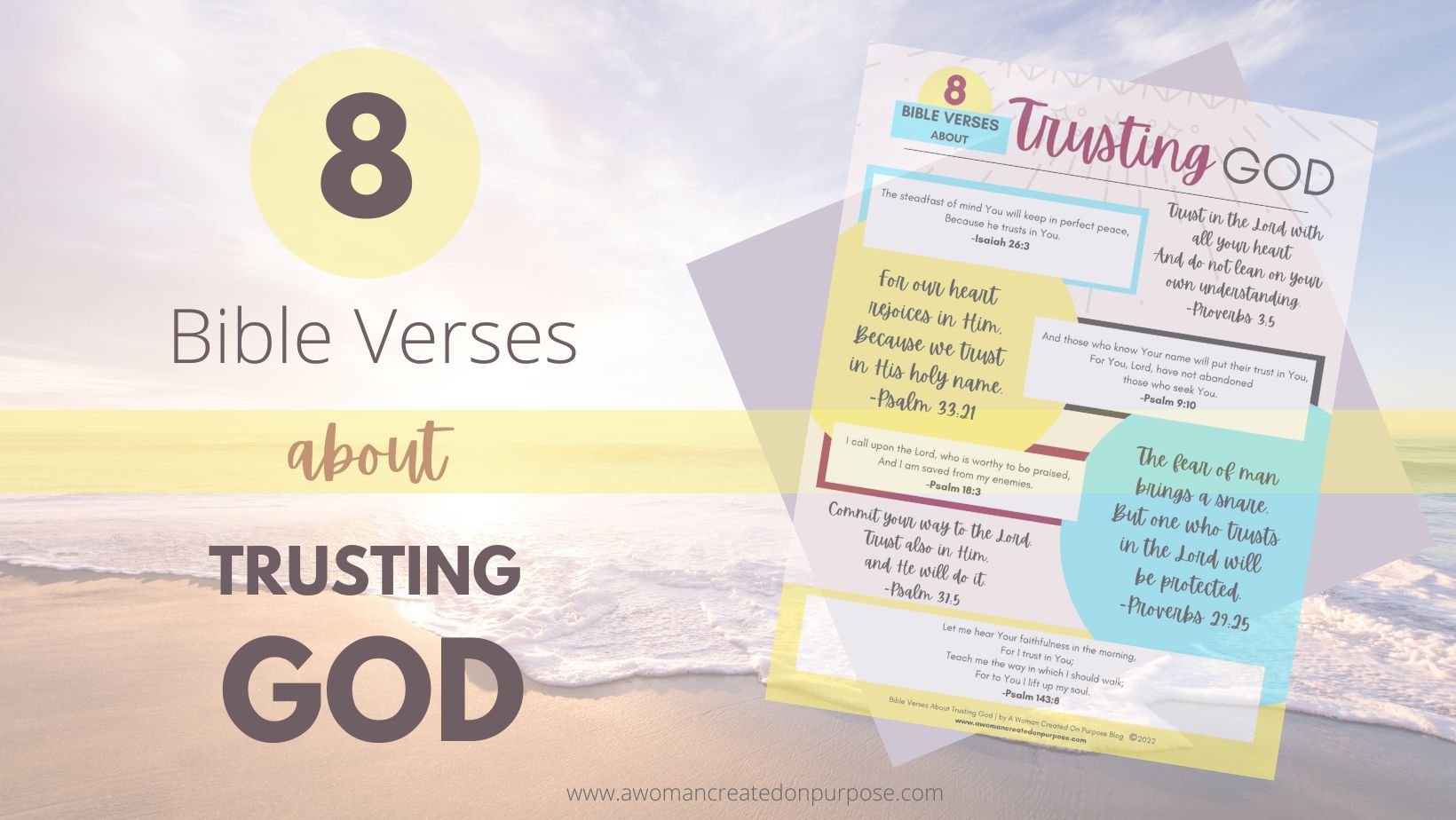
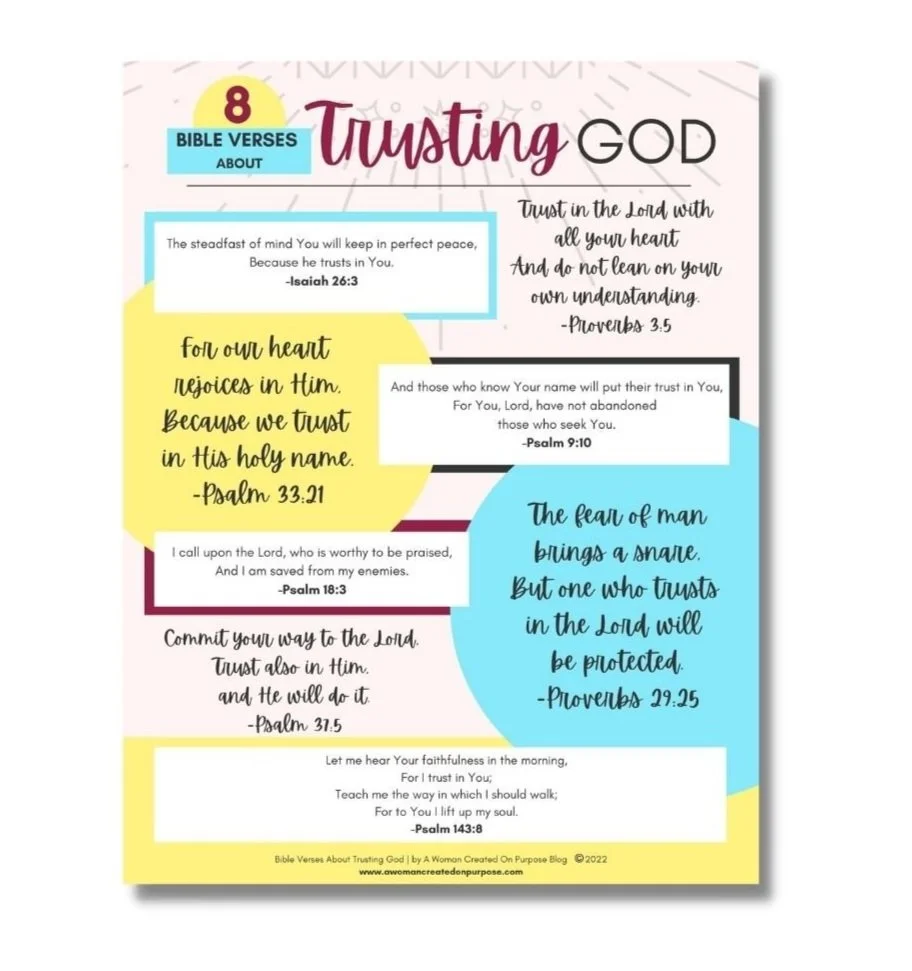
Instead of listening to the negative rhetoric that can flood our minds during difficult times, let’s fill our minds with the power of God’s Word.
Use the form below to receive your FREE Download featuring 8 Bible verses about trusting God in difficult times. Print it, hang it on your mirror, or carry it with you for a reminder of God’s goodness throughout the day.
#8: Don’t forget to grieve.
It’s ok to grieve. Whatever needs to be grieved, sister, do that. You don’t have to bottle it up or hold it in. You are not weak because of it. The Lord is near to the brokenhearted (Psalm 34:18), and He hears your every cry.
#9: Don’t wait for your circumstances to change to bring you joy.
Our circumstances are not our source of joy. Joy comes from the Lord– from being in His presence (Psalm 16:11). When you’re walking through a tough time, don’t fall into the lie that you have to wait for things to get better before you can experience true joy. Draw close to the Lord, and allow Him to fill you with His peace and joy.
#10: Don’t carry the burden on your own shoulders.
Tough times are heavy. Feelings, thoughts, and emotions can weigh you down if you let them. But, the Lord tells us to give Him our cares, anxieties, and worry (1 Peter 5:7; Psalm 55:22). Sister, remove the weight from your shoulders– you are not strong enough to go it alone. Allow Him to carry you through and remove the burdens you’re used to internalizing.
#11: Don’t try to avoid your circumstances.
Like David, acknowledge what you’re going through. Pretending as if everything is fine or sweeping all doubts, fears, and emotions under the rug are not healthy ways to cope with tough times. Ask the Lord for His perspective in the matter, see things for what they really are, and seek to walk through it according to His leading.
“You will make known to me the way of life;
In Your presence is fullness of joy;
In Your right hand there are pleasures forever.”
The Lord Triumphs Over Tough Times
Tough times can’t be avoided. In fact, they’re a guarantee we face in this life (John 16:33). The key, sister, is relying on the Lord. Walk hand-in-hand with Him every step of the way. He is ready, willing, and waiting for you to seek Him more deeply, see Him more clearly, and love Him more wholeheartedly through your trial.
Remember– He is the One who saves you from all troubles. Praise His name.
more articles to help you grow in your faith
Trusting God as Jehovah Jireh
It can be difficult to see up ahead, can’t it? We want to. We try to peer into the future as…
It can be difficult to see up ahead, can’t it? We want to. We try to peer into the future as far as we can see, calculating steps along the way, obstacles that will surmount, and triumphs we’ll make. We squint with all of our might, but the truth is, our finite minds can only see so far.
We can only come up with so many scenarios and so many “best” routes and possible outcomes.
We aren’t God.
Shortly before my daughter was supposed to start kindergarten, I was squinting hard. You see, my husband and I had talked since before she was born about how we planned to homeschool our kids. After numerous years of digesting our thoughts and praying over them to be sure it was something God was calling us to do, we discovered that yes, homeschooling was the route we were to take.
Yet, with the school year quickly approaching, I still found myself sitting in front of a computer every day at my full-time job. I knew working and homeschooling simultaneously wasn’t what the Lord had for me, and I’ve always had the strong desire to stay home with our kids; so, why did I sit at my desk, hesitant to back away?
As I shared in my 2-Part series about the idols we have in our lives, I struggled with leaving work because I didn’t think we could survive as a one-income family.
Even though I knew the Lord was calling me to stay home, I held onto the false belief that my monetary contribution to our family was greater than what God could do for us on one income.
Deep in my heart, I didn’t honestly believe that He could provide for us. I didn’t trust God’s promise of provision.
RELATED: Modern Day Idols in Your Life

God’s Provision is always available
But God.
He allows us to go through trials, be tested, and face hard decisions so that we can learn to trust in Him more.
According to Merriam-Webster, the word “provision” means the act or process of providing. It can also be thought of as a measure taken beforehand to deal with a need or contingency.
So when we fully understand provision, we can see that not only does God provide in terms of providing what we need at the moment, but He also provides what we need to prepare us for things to come.
This may not be obvious to us at the time (we can’t see into the future, remember?), but He’s putting the puzzle together for us. He knows what the full picture on the puzzle box looks like; we see just one puzzle piece at a time.
Release Your Grip and Grab God’s Provision
Please know that God’s provision is always there for His sons’ and daughters’ taking, but we don’t receive the blessing of His provision if our fists are clenched, tightly gripping what He’s asked us to release.
Maybe it’s something we have to physically let go of, like a job; or, perhaps it’s a decision we face that requires us to step out in faith. Whatever the case may be, the more we try to gaze into the future through our strongest prescription lenses, the more we are relying on ourselves, and not on God.
“God’s provision does not need our assistance. God will provide because He is good, gracious, and loves His children.”
So, when I finally took the step of faith and left my job to stay home and homeschool our daughter, I got to see the power of God’s provision firsthand. Of course, I’d seen it before; but this time it was evident to me. My husband’s income increased, expenses we previously struggled with were covered, and it was not stressful in the least bit.
I had the Lord’s peace.
And now, four years and counting— through various job changes and losses— God is still providing for us as a one-income family.
Bitter Sweet
Many of us are likely familiar with the events that transpired for the Israelites following their exodus from slavery in Egypt.
As we step into the scene in Exodus 15, the Lord had just saved the Israelites by parting the Red Sea for them and then closing it on top of the pursuing Egyptians. They praised the Lord in song, and as they entered the Wilderness of Shur, they found no water that wasn’t bitter in Marah.
God had just saved them through water; would He allow them to die by lack of water?
No. There, in Marah, the Lord miraculously turned the bitter water into sweet water. Traveling on, they came to Elim, where there were not one, but twelve wells of water.
First, parting waters. Next, sweet water; and then, an abundance of water.
God provided.
The Story of Manna
It’s easy to forget God’s provision sometimes, isn’t it sister? This is what the Israelites did. Just a month and a half after they witnessed the parting of the Red Sea, freedom from slavery, and more recently— fresh, sweet drinking water, they began to complain.
Exodus 16:2 says that the whole congregation of Israel complained against Moses and Aaron. Not just a few of them. All of them. They complained because they lacked food in the wilderness, yet had plenty to eat while in the hands of the Egyptians.
Despite recently witnessing the power of God through the 10 plagues in Egypt and the miracles that followed, they forgot about God’s ability to move His mighty hand.
But God.
God is Jehovah Jireh. He has compassion. He cares. He provides (even when we complain a little bit!).
The Israelites once again had a chance to view God’s provision, this time in the form of manna from heaven. God would rain down this manna each day; they only had to collect it according to the measurements the Lord instructed and trust Him that it would be enough (Exodus 16:16).
Since He promised to make it rain down every day, why did they have to trust Him that it’d be enough?
Because they were only to gather so much per person, and they couldn’t leave any leftovers. Some followed this command. Others lacked trust in God’s provision and tried to save some for the next day. The result– it spoiled (Exodus 16:19-20).
“And the Lord said to Moses, “How long do you refuse to keep My commandments and My laws?””
But, here’s the thing about God’s provision. God is in control. Even after He gives it, He’s still in control.
We see this in the fact that the Lord instructed them that on the day before Sabbath they could gather twice as much manna because He would not rain down manna on Sabbath. Whatever manna they gathered and was leftover for Sabbath did not spoil. This shows that God was in control of His provision and whether He allowed it to spoil or not (Exodus 16:24).
We also see in Exodus 16:21 that the Israelites had to be disciplined to gather manna early in the morning.
Why? The manna melted when the sun got hot. God was in control of His provision. His desire was for them to trust in Him as He provided, but He also didn’t want them to be lazy as they trusted in His provision. He provided, but they still had to be diligent to do their part, according to the instructions He gave them.
Trusting the Lord as Jehovah Jireh does not mean we sit around with our feet kicked up. We allow the Lord to work in our lives, being mindful of what He is simultaneously asking us to do.
What does Jehovah Jireh mean?
Jehovah Jireh is one of the most well-known names of God in the Bible. We see it mentioned shortly after God tells Abraham to sacrifice his son Isaac, yet in the midst of Abraham’s obedience, God provides a ram to be sacrificed instead.
“And Abraham named that place The Lord Will Provide, as it is said to this day, “On the mountain of the Lord it will be provided.” ”
Even given what many would consider the most soul-troubling of commands— to sacrifice your own son— Abraham’s faith in God did not waver.
In fact, his faith was so deep-rooted that he didn’t hesitate, and fully believed that no matter how God carried out His purposes— whether God would provide a lamb for the burnt offering (Genesis 22:8) or God would raise Isaac from the dead (Hebrews 11:19)— that he told the servants who had traveled with them to Mount Moriah that after the sacrifice, “we will come back to you.” (Genesis 22:5)
He said “we”, not “I”. Did you get that?
Abraham trusted in God’s provision; but more importantly, he trusted in God Himself— Jehovah Jireh.
Don’t Miss the Next Post. Subscribe!
Subscribe below for weekly encouragement and practical how-to tips for your Christian walk, straight to your inbox.

How to Trust God: 10 Practical Tips
Coming to grips with how to trust God in our needs is possible, sister. Will we make mistakes sometimes? Yes. Will we forget what He’s done in the past as we approach a new situation? Sometimes. But, there are a few lessons we can learn from Abraham, and the countless descendants that came through the line of his “almost” sacrificed son, Isaac.
#1: Seek the Lord in your need.
Get to know Him. Stay close to Him. Cry out to Him, and He will hear you.
#2: Know that the Lord will never lead you astray.
Isn’t it amazing that Abraham, having never seen God raise someone from the dead, would have enough faith in the Lord to believe He could! As illogical as God’s commands may sound sometimes, know that His wisdom is infinite and He knows what He is telling you to do.
#3: Step out in faith.
Just believe. Search the Scriptures for Bible verses about trusting God, re-read Hebrews 11, and then go read the stories of each person mentioned in the Hall of Faith. You will be encouraged.
#4: Remember God’s provision in the past.
Think about the small and big ways the Lord has provided for you in the past. It will ignite your faith in trusting Him with your future.
#5: Praise the Lord.
Just as the Israelites praised Him in song after they left Egypt, you can praise the Lord as you see His goodness in your life. Write the praises in a journal so you can turn back to them in the future. Journaling will help you immensely with tip #4!
#6: Follow the instructions the Lord gives you.
Don’t go looking for manna on the Sabbath! Sister, the Lord tells you the things to do for a reason. His directions don’t need your editing or manipulation.
#7: Be diligent.
Be a good steward of God’s provision in the way you handle it, keep it, and use it.
#8: Prepare for hard decisions.
Sometimes what the Lord calls you to do may be hard. You may have to wait longer than expected before you see His provision. That’s ok. He knows what He’s doing. Do you believe that?
#9: Expect to see Jehovah Jireh.
He can provide. He will provide. Trust and believe that He will do all He says He will do.
#10: Stay in prayer.
Communication with the Lord is crucial. He is your lifeline. As my pastor always says, “Don’t hang up the phone!”
Bonus Tip: Take a few minutes and read Psalm 78 which gives insight into many of the things we discussed in this post!
Be Encouraged
Sister, God is ready and willing to provide for you, just as He has for countless people since the beginning of time. He loves you, and won’t leave you hanging. God’s provision is real.
Don’t make the mistake I used to, trying to see too far up ahead into the distance. Objects in the mirror are closer than they appear. The Lord is near. Refocus your eyes. He’s right here.
Here's a Reminder of Your Worth, Sister
Dear Sister who has lost sight of her value at the moment:
Maybe you’re so weary of what the world is telling you is right– how to look, what to believe, what’s important in life. You can’t seem to…
A Brief Note of Encouragement
Dear Sister who has lost sight of her value at the moment:
Maybe you’re weary of what the world is telling you is right– how to look, what to believe, what’s important in life.
You can’t seem to keep up with your friends and the “perfect” lives they display on Instagram. Everyone else is married. Everyone else is having kids. Everyone else is taking amazing vacations.
You feel disappointed by the way you’ve been treated. You’ve been ignored and left alone. You feel like even God has moved farther away.
Your children buck at your parenting skills and think your ways are so “mean.” Nothing you say seems to matter. You’re beginning to think that you can’t do anything right.
Well, Sister, shatter these lies in your mind with the power of Scripture. I’m here to tell you that the Lord has something different to say about your worth:

You were made perfectly, just the way you are.
For You formed my inward parts; You knitted me together in my mother's womb (Psalm 139:13).
There is nothing wrong with you. Don’t let the world tell you anything different. If you are in Christ, you are a daughter of the Most High King. He didn’t mess up when He made you. You are the way you are because he knit you together that way. Your looks, your personality, your silly quirks, and those things you get compliments on all the time– they were all hand-picked and flawlessly designed by Him.
God’s work is wonderful— including you.
I praise You, for I am fearfully and wonderfully made. Wonderful are Your works; my soul knows it very well (Psalm 139:14).
Everything the Lord created was good (Genesis 1). This includes you. You are part of His works, which means you are wonderful. You don’t have to try to be wonderful. You don’t have to perform or do more to be wonderful. The original version of you is wonderfully made.
You were purposefully created, down to the most intricate details.
My frame was not hidden from You, when I was being made in secret, intricately woven in the depths of the earth (Psalm 139:15).
God didn’t create you with His eyes closed. He didn’t just “throw you together.” Why do so many of us treat ourselves as if He did?
That thing you don’t like about your body, the quirks others have made fun of you for— all of those things have a purpose in your life. Instead of being disappointed that you don’t look or act like someone else, seek God and discover His thoughts behind the intricate details that make you your wonderful self.
“And God saw all that He had made, and behold, it was very good.”
God has fashioned you and your days.
Your eyes saw my unformed substance; in Your book were written, every one of them, the days that were formed for me, when as yet there was none of them (Psalm 139:16).
Not only did God see you as He created you, but He also sees you now and all the days of your life. He is El Roi, the God who sees. Nothing that happens to you or that you decide to do comes as a surprise to Him. He’s the glue holding all of your life together, weaving each strand of fabric into a beautiful tapestry to represent your life. He is the greatest fashion designer of all time.
The Maker of the universe has precious thoughts about you.
How precious to me are Your thoughts, O God! How vast is the sum of them! If I would count them, they are more than the sand (Psalm 139:17-18).
When you feel overlooked or forgotten, remember that the Lord has countless thoughts about you all the time— precious thoughts.
If He created you, intricately, purposefully, and wonderfully, does that not mean that He calls you “good” and He is proud of His work? If this is the case, are not His thoughts of you, His daughter, good as well?
Your negative thoughts and feelings about yourself hold no weight against His. Dispel those thoughts. They are not the truth. What comes from the Lord, your Master Maker is truth.
Whether sleeping or awake, the Lord is happy to be with you.
I awake, and I am still with You (Psalm 139:18).
When no one else understands you. When not a single friend is by your side. When you know you’re innocent but no one believes you. When your head hits the pillow at night and you feel guilty about how you treated your kids, believing the lie that you’ve severely damaged them and they won’t forgive you.
In all of those times, the Lord is right by your side. He will not leave you, so don’t leave Him.
Take comfort in knowing that because He sees you and every detail of your thoughts, actions, and days, He knows who you truly are— yet still is happy to be with you.
He doesn’t flee when things get tough. He isn’t embarrassed to be seen with you because He’s not sure what others might think. He isn’t afraid of gossip.
He willingly fights for you, defends you, and goes to bat for you. You don’t have to be strong enough. He is with you and in Him is your peace, joy, and strength.
Find your value in the Lord
So Sister, will you join me in remembering who our God is? How He fashioned us? How He delights in us, His daughters?
The world will always tell you that there’s just “one more thing” you have to do or accomplish to become valuable. Whether it’s a career change, a fashion change, or a personality tweak. But God—
He tells us that we are already precious, valuable, and wonderfully made. He sent His only Son to die on the cross so we could have a restored relationship with Him. And even if you were the only person created in the world, He still would have sent Jesus to die for only you.
He bought us at the ultimate price and we can’t be stolen or let alone bought back— which makes us priceless.
Let’s find our value in Him and Him only. You are worth every moment He spent creating you.
Free Downloads & More
If you’re looking for simple, effective tools to help you in your daily walk with the Lord, we’ve got you covered.




you may also like to read:
Humility in the Midst of the Unknown: A Lesson from Mary
It may seem weird to pair the word humility with the word unknown. Normally, when we’re thinking about journeying into the unknown, we’d…
It may seem weird to pair the word humility with the word unknown. Normally, when we’re thinking about journeying into the unknown, we’d use the word trust, or maybe even faith.
But humility is appropriate too. That’s because it’s the arch-nemesis of humility– pride– that sets off our struggle as we step into the unknown.
Pride hinders us from fully trusting the Lord and walking in faith.
I have first-hand experience in this area. August 2012 was initially like any other hot, summer August. I was working full-time during that season in my life, but I had a lot of paid time off I needed to use before the end of the fiscal year. So, during those weeks at home, I had a lot of quiet time with the Lord.
Before you jump to the conclusion that this was a beautiful, serene time— let me stop you right there. You see, we hadn’t had kids yet, but I felt the Lord strongly pressing upon my heart that it was time to start our family.
For someone whose only dream when growing up was to be a mom, you’d think I would have jumped at the Lord’s calling. But, I didn’t. I hesitated.

A lack of humility
At the time, we had people in our lives who truly wanted what was best for us and would help us to “stay on the right track” by offering advice and counsel. Nothing wrong with this– as long as it is godly counsel from a biblical perspective and worldview. In fact, Proverbs 11:14 tells us that there is safety in a multitude of counselors.
Encouraging us to make sure our finances were better first, or get out of debt, or buy a home first… these were some of the things we heard in terms of whether or not we were ready to have kids. Again, none of this was inherently wrong advice. The Bible tells us we should be good stewards of our money.
The only discrepancy with the advice was that I had a strong conviction from the Lord. He spoke directly to my heart about starting a family.
I hesitated with the Lord’s calling because I was too busy listening to everyone else’s counsel.
As I look back, my faith and reliance on the Lord were not as strong then as they are now. Be that as it may, I don’t recall the Lord ever bringing those personal finance matters to mind. They weren’t any of His concern– He simply called me to start a family.
It was my job to trust Him and proceed. Yet, the sin of pride was what kept me listening to others’ counsel overtop of the Lord’s.
RELATED: Trusting God When You Can’t See His Bigger Plans
Pride makes you wrestle with God
So that August, as I had time off work— time to be alone and commune with the Lord, He brought me to my knees. I call it my Jacob experience. You know, the time the Lord wrestled with Jacob at Peniel (Genesis 32:22-32).
I began feeling very irritable, emotional, and depressed, crying almost every day. This is how it began. Over the course of about 2 weeks, I agonized over the decision to get pregnant as the battle between man’s counsel and God’s counsel waged war in my mind.
It was a trying time— painful, confusing, and intense. Once I truly recognized what was going on, and that this was the Lord’s way of getting my attention, it all became clear.
He brought me out of my pride and into humble submission to the plans and purposes He had for me. He prevailed, His plans prevailed, and He showed me that what He calls me to do, I can only willingly do in submission to His will– once I remove the pride.
“Before destruction the heart of a person is haughty, But humility goes before honor.”
I had to remove the pride of: My plans are better; I need to fix things on my own before I do this; or, This idea sounds good, God, but I was thinking…
Pride keeps us in a place where we walk the dangerous line of destruction, falsely deceived into thinking we know best.
But we don’t. His ways are not our ways, and His thoughts are above our thoughts (Isaiah 55:8).
Pride holds us back from purposely living for the Lord.
Pride makes us walk by sight, not by faith.
Humble Submission
When the Lord calls us to a hard decision, we cannot fully operate within the safety of His will when pride fills our hearts. We must allow Him to remove it.
Once we do, we can enter into a place of humility before Him, where we can bow to His will, and from there, humbly submit.
Once we humbly submit, then, ultimately, we can walk in faith. And, when we walk in faith, we have the peace that only the Lord can give us.
By the end of that August, after humbly submitting to the Lord’s timing, I was pregnant with our first child, who we welcomed into the world that following spring.
RELATED: How to Accept the Peace Jesus Offers
Finances weren’t an issue. It didn’t matter that we still lived in a two-bedroom apartment. It made no difference that we weren’t out of debt. All we needed was provided. Jehovah Jireh.
Because He is the Lord our God. And that is what He does.
Humility & Submission as Seen in Mary
We can look to Mary in the Bible, Jesus’s mother, as an example of what humility and submission look like. She is an amazing example of being willing to be used by the Lord, no matter the cost.
Unlike me, she did not buck at the calling the Lord gave her for weeks on end. She didn’t wrestle with Him for many days as she contemplated what others were telling her about her life.
When the angel Gabriel appeared to give her the message that Jesus would be conceived in her womb, she didn’t say ‘No.’ She didn’t say she wasn’t willing, or “What about this…?”. Her only question was a logistical one when she asked how this could happen since she was a virgin (Luke 1:26-34).
She didn’t even speak about the possible consequences of accepting a calling like this– being looked at as an adulterer, or how others would view Joseph, to whom she was betrothed.
No– her next words are ones we can all learn from:
“And Mary said, “Behold, the Lord’s bond-servant; may it be done to me according to your word.””
Looking for simple, practical ways to live life on purpose?
Subscribe today!

Humility in the Bible
Humility is a heart attitude. It displays itself in our lives when we possess meekness, and we see ourselves rightly compared to God. Got Questions states, “True humility produces godliness, contentment, and security.”
Humility shouts, He is God; I am not.
Proverbs 22:4 says, “The reward of humility and the fear of the Lord are riches, honor, and life.” (NASB)
Pride is never rewarded. In fact, the Bible says repeatedly that pride comes before the fall, before destruction, and that the Lord will humble the proud (Proverbs 16:18; Proverbs 11:2; Proverbs 29:23; James 4:6).
Instead, humility comes before honor (Proverbs 18:12). We can never truly and honestly submit to the Lord without humility. He honors those who do, just as He did with Mary. She became the mother of our risen Lord, and was loved and cherished by Him throughout His time here on earth.

So, what can we learn from Mary? In times of uncertainty– when the Lord is calling us to a place or to circumstances unknown, like Mary we can grow in our faith in these ways:
#1: Listen intently to what God is calling you to do.
As Gabriel spoke his message from God straight to Mary (Luke 1:28-33), she didn’t interrupt or overthink it. She didn’t jump from “A” to “Z”, wondering about all of the letters in between. There was no verbal comeback or hint of extreme disbelief in her response.
You too can have this heart attitude. Be still and quiet long enough to actually hear what the Lord is saying. Make sure you understand His Words and the things He is pressing upon your heart. Don’t immediately jump to conclusions or get wrapped up in the details.
#2: ALLOW GOD TO HANDLE THE DETAILS.
After she heard the message, her only question was simple (yet, I’m sure all of us women completely understand why she’d ask that!). She just needed a tiny piece of the puzzle to help her make sense of it all, and that was that.
God is not the Author of confusion. Even if He calls you to do something but doesn’t give you a bunch of details (which is often the case!), it profits you nothing to try and figure out “how to get there” or what you’ll do when you arrive.
God will provide for you, sustain you, and keep you every step of the way.
#3: Take the Lord at His word.
Gabriel explained to Mary that the Holy Spirit would come upon her, and her child would be called the Son of God. In case she needed more encouragement in the power of the Lord, Gabriel also gave her word that her cousin Elizabeth was pregnant in her old age (Luke 1:35-37).
Mary simply took the Lord at His word, believing all of these things immediately– not because she thought she was worthy, but because she knew her God. She knew her God was big enough to handle all the details. To work things out. To give her the grace and steadfastness she needed to live out this calling.
Sister, do you take the Lord at His word? When He calls you to something big or small, or something a little frightening, do you respond in a way that presents yourself as a humble servant, ready to do His will?
He is the same God now as He was back then. If He entrusted Mary with carrying the Savior of the world in her womb, will He not also trust you to carry out whatever task He is calling you to?
SISTER, LET’S Walk by faith.
Please don’t be like I was during that hot August in 2012. Please don’t buck at the Lord’s word. Please don’t listen more to the counsel of others— no matter how godly it may be— if you have a clear conviction from the Lord.
Trust me, it doesn’t end well. Until…
You submit. You bow in humility. You release the pride. You let the Lord have His way.
His way is always best for you. You can’t see the full picture. You don’t know everything that lies up ahead– all the blessings, the honor, and the ways your life will glorify Him.
But He knows.
So trust Him, sister. Humbly submit. Step out in faith.
He can’t wait for your relationship with Him to grow more deeply as you do.
YOU MAY ALSO LIKE TO READ:
To the Woman Who Can't See Her True Beauty
No matter what the world tells you real beauty should look like. No matter who is on the cover of the trendiest magazine. No matter what the…
A Brief Note of Encouragement
Sister, come on in. Grab a cup of coffee. Have a seat. Listen to me very closely:
You are a woman of incorruptible beauty.
No matter what the world tells you real beauty should look like. No matter who is on the cover of the trendiest magazine. No matter what the mean girls said to you when you were in high school.
You are a woman of incorruptible beauty.
No matter how that outfit fits you today. No matter how much that bad haircut gives you a perpetual bad hair day. No matter how unkempt you feel as you look at the Instagram of the latest beauty influencer.
You are a woman of incorruptible beauty.
Even though you believe you are the least put-together mom in the car line. Even though your shoes are less fashionable than those of the woman sitting in the row behind you at church. Even though your co-worker’s latest highlights give her that flawless summer look, and you haven’t had your hair professionally done in 10 months.
You are a woman of incorruptible beauty.
Even though you compared your non-workout physique to your friend’s sculpted body yesterday. Even though you are rarely complimented on your outward appearance. Even though the mom next to you gave you a sideways glance as you fed your children cheeseballs for a snack instead of organic, sugar-free granola bars.
You are a woman of incorruptible beauty.

Even if I’ve never seen you, I can say you possess beauty. Imperishable beauty. The type of beauty that no one can ever strip from you.
Why?
your beauty comes from the Lord.
1 Peter 3:3-4 tells us that our adornment shouldn’t solely be our outward appearance, but instead, it should be the hidden person of the heart.
A heart that yearns for the Lord. A heart that trusts in Him. A heart that desires to know Him more deeply.
A heart wherein its satisfaction, value, and worth come from the Lord produces an incorruptible beauty in the form of a gentle and quiet spirit.
This type of beauty doesn’t change with the trends. It’s not validated by the amount of Instagram likes it receives. It doesn’t go out of style.
“So the King will greatly desire your beauty; because He is your Lord, worship Him.”
A quiet spirit is incorruptible beauty.
Quietness means there is rest, peace, and calm. You can focus on the Lord in quietness. In the quietness of the Lord’s presence, you drown out the noise of the world shouting what “true beauty” is. This quietness means you are “undisturbed from without”.
As you lead a quiet life, keeping your focus on the calling the Lord has placed in your own life, you honor Him (1 Thessalonians 4:11). Because you see— this “hidden person” is not really hidden. She is not hidden from the Lord. He sees the inner place of your heart; the quietness of your soul.
A gentle spirit is incorruptible beauty.
The gentleness you portray in your thoughts, actions, words, and deeds is beauty in the sight of others. Because you desire to be gentle and lowly in heart, like Jesus, you are beautiful. In this humility, you find rest for your soul (Matthew 11:29).
A fear of the Lord is incorruptible beauty.
In your humble fear of the Lord, you glorify Him. And, let it be known that incorruptible beauty exudes from within you when you glorify Him.
Because you seek the Lord, yearn for Him, and get to know Him better, you are a woman who fears the Lord.
Because you fear the Lord, your beauty is hidden inside the deepest depths of you. It is precious to God.
You, yes you, are precious to God.
And your beauty can never be stripped away.
Your reverence to your Lord is incorruptible beauty. Your respect and biblical submission to your husband is incorruptible beauty. Walking out the fruit of the Spirit in your parenting is incorruptible beauty. Honoring the Lord in your quiet time is incorruptible beauty.
“Charm is deceitful and beauty is passing, But a woman who fears the Lord, she shall be praised.”
Sister, today I encourage you to know your worth.
Understand your value in the Lord. Meditate on the fact that you are a daughter of the King. Remember the mercy He sheds and how His grace abounds in your life.
sister, today I exhort you to look in the mirror.
Look in the Lord’s mirror– this morning; before you go to bed; tomorrow; next week. The reflection He provides you with outshines whatever standard of beauty the world is dying to impose upon you.
The world’s charm is deceitful and its definition of beauty is ever-fleeting. Don’t give in to these things.
No– today, purpose to wear your quiet and gentle spirit well. Fashion yourself in the fear of the Lord.
Can you see it, sister? Do you see yourself in the mirror?
You look like someone who is precious in the sight of God.

If this post encouraged you, don’t be shy— SUBSCRIBE! Let’s link arms and encourage one another. You’ll receive weekly encouragement straight to your inbox.


Lies We Believe About Idols (Part 2)
Idols. A word we sometimes think we don’t wrestle with. A word that seems foreign, Old Testament, or outdated. But…
Idols.
A word we sometimes think we don’t wrestle with. A word that seems foreign, Old Testament, or outdated.
But it’s not.
This is Part 2 of the series, The Lies We Believe About Idols. In Part 1, we discussed what the Bible says about idols, and answered the question, What is an idol? We also dove into the first 5 lies that we can tend to believe about idols.
If you missed Part 1, you can read it here. You’re going to want to start there before continuing on to the next 5 lies!
Before jumping into the lies, let’s remember that the things in which you find your identity, and the things that fill your mind and your heart can easily become idols.
Even if you’re not prone to propping up a shiny object on your shelf, you still may have an idol taking the place of the Lord in your heart.
So, let’s take a look at a few more things the world is telling us as it tries to weave these lies into our hearts.

Lie #6: Your image matters.
I remember being a teen and looking through beauty and fashion magazines to get an idea of what “beauty” looked like. If it wasn’t a magazine, it was the latest teen icon or music video star whose look I’d try to emulate.
Today, we don’t have to wait for our magazine subscription to come in the mail, or wait for a commercial break to end to see something on tv. Every young teen and woman has the ability to find models of “beauty” with a few thumb swipes or clicks.
But, this thought of bearing the perfect “image” is nothing less than an idol mentality, which ironically, just as in social media posts, puts a filter over the true meaning of being image-bearers.
How to improve your self-esteem and self-image are hot topics, but we’re being taught to look in the wrong places to find the answers.
Made in the image of God
The truth is, our image does matter, but not as the world tells us.
The Bible tells us we are made in the image and likeness of God (Genesis 1:26). What’s so important about this is that we are the only part of creation that God bestowed this blessing. Being made in His image sets us apart from all other aspects of creation, even animals. You can find a great explanation by Got Questions about being made in God’s image.
“For as by the one man’s disobedience the many were made sinners, so by the one man’s obedience the many will be made righteous.”
Bible verses about image
As 1 Corinthians 15:45-19 states, although we bear the image of the first man (Adam) and his sin, we who are in Christ also bear the image of the second Adam (Christ). We are new creations in Christ and what He calls us to put on as we walk in newness of life is important (Colossians 3; Ephesians 4:24).
The fact that we are seen as righteous before God is important (Romans 5:19). The amazing truth that God knit us together in our mother’s womb, perfectly made to look exactly the way He wanted us to look is important (Psalm 139:13-14).
The world’s beauty standards for our lives are not important.
Do not be deceived, dear sister, in thinking that we need to look a certain way to be justified. There is nothing wrong with having a nice wardrobe, wearing makeup, and taking care of your physical appearance. Please hear me and do not misunderstand.
The problem starts when we become so obsessed with our looks that we think our value and worth are bound up in them.
If we are “so beautiful,” we are more valuable. If we think we don’t measure up to the world’s standard for beauty, we’re less valuable.
When we believe these lies, we’re putting more stock in how He made us, as opposed to our Maker, Himself. We are the clay questioning the potter (Isaiah 45:9), all because the world tells us that perhaps we aren’t good enough.
Let it be known that the world holds no greater wisdom than God. He knew what He was doing when He made each of us. Let’s stop focusing so much on our self-image and instead marvel at our God-image.
Lie #7: You’re justified by the number of your social media followers.
The end result of being justified is peace. We think we can find peace in having a lot of people following us, peering into our lives, and “liking” the things we do. The world will tell us this is a great way to have a plethora of people thinking of you and caring about you.
Unfortunately, this is a form of craving worship and idolization.
“ Therefore, having been justified by faith, we have peace with God through our Lord Jesus Christ.”
Comb through the Gospels and find all of the times it says that many who heard and saw Jesus stopped what they were doing to immediately follow Him. Then, find the many times Jesus specifically calls people to follow Him. I don’t recall a time when Jesus paused His ministry, asked where someone else was going (from a standpoint of their philosophy or ministry), and said He would follow him.
Justified by Faith
We are justified by our faith (Galatians 2:16, 3:24; Philippians 3:9; Hebrews 11), not by our followers. We can aspire to be the next top social media influencer, but what is our platform? What are we trying to influence others to do?
Can you share the love of Christ while building a social platform doing makeup tutorials? Yes. While sharing helpful DIY videos or cooking tutorials? Of course.

None of these platforms are bad. And, if you’re putting out helpful content that blesses people, then organically you’ll gain social followers. Again, please don’t misunderstand me.
With all of these Lies, what we’re talking about is your heart attitude. Your motivation. Your reason for doing these things.
Check that first before journeying down any road that might tempt you to make your knowledge and social media following your main objective, for that is the moment the shiny object hops on the shelf of our hearts.
Lie #8: Your finances save you.
I’m sure it’s no surprise to you that idol worship can undoubtedly include the love of money.
The trouble with money doesn’t come when we have a lot– there is nothing wrong with wealth if the Lord chooses to bless you in that way. We see many examples of Old Testament saints who had wealth, such as Job.
The problem with money also doesn’t come when we have a little. Living in poverty or being poor does not mean you have any less faith than someone with money.
No, the trouble begins when we look to our finances to be our savior.
“Make sure that your character is free from the love of money, being content with what you have; for He Himself has said, “I will never desert you, nor will I ever abandon you.”
Our money will come and go. Our money is temporary. But, as the verse above says, God will never leave us. Christ is our savior.
God’s Provision
Several years ago I was wrestling with the decision of whether or not to be a stay-at-home mom. I struggled with leaving work because I didn’t think our finances could handle it. Even though I knew the Lord was calling me to stay home, I held onto the false belief that my monetary contribution to our family was greater than what God could do for us on one income.
Deep in my heart, I didn’t truly believe that He could provide. I didn’t truly believe that He was and is in fact, Jehovah Jireh.
After much prayer and encouragement from those who’d walked through the same situation earlier in life, I decided to leave my job and stay home.
And guess what? We went broke and became homeless.
KIDDING!!! Totally kidding!
No, God provided. Of course, He provided. He wouldn’t have called me to stay home if He didn’t already have plans to provide for us.
But we think crazy thoughts like that sometimes, don’t we? We think, There’s no way I could take that step, move to this place, take this lower-paying job, or go into full-time ministry… Or, we think, If only I had more money, then I’d be able to do…. or go… or live this way…
When we live in fear of how our lives will turn out due to our lack of money, or when we place all of our hopes and dreams in the aspiration of what having more money could do for us– we have made our finances an idol.
jehovah jireh
We need to know, remember, and believe that the Lord will provide. We need to bask in the truth of God’s provision. God is the only one who supplies all of our needs according to His riches in glory in Christ Jesus (Philippians 4:19), and the Bible tells us that that’s exactly what He will do.
Our trust needs to be in Him, not our next paycheck. Not in our IRA. Not in our next promotion.
We are much more valuable to Him than the ravens (Luke 12:24) and He supplies all they need. Will He not do even more for His beloved?
Lie #9: People-pleasing is the only way to go.
According to Verywell Mind, people-pleasing generally involves people “feeling overly concerned with pleasing others and earning their approval as a way to maintain relationships.”
Although people-pleasers are seen as extremely helpful, kind, and giving– oftentimes, the underlying motivation in doing so is to gain the affection of others with the ultimate goal of gaining their approval. Their motive is to seek validation.
Even though they appear to have a humble attitude, it’s actually a form of pride.
how are we called to serve others?
Jesus calls us to be servants (Matthew 23:11), but in that serving, we need to operate under godly wisdom and discretion in how and when we serve.
As we see in the story of Mary and Martha (Luke 10:38-42), we need to know when we should be wholeheartedly giving of ourselves in serving others, and when we need to attend to our own spiritual needs. There is a fine line to tread.
The bottom line is that Jesus doesn’t call us to be all things to everyone at all times. That is His job. Just because we are capable of doing something, doesn’t mean we should.
Before committing our time and energy to fill a need, we should seek counsel from the Lord. We can pray and ask Him if this is something He’s calling us to do at that moment. He may have a greater need He needs us to fill elsewhere. Or, like Martha, maybe He’d rather just have us sit at His feet.
Are you number one or do you even matter at all?
What’s interesting is the extreme that exists between this lie and Lie #1: You are number one. If we aren’t supposed to be thinking of ourselves first, then we are to be thinking of everyone else first.
Either you’re the only one who matters, or you don’t matter at all.
This is one reason why we need to be so in tune with what the Word of God says. We can be easily swayed between these two opposing mindsets, living a very confused life. But God is not the God of confusion. He does not create dichotomies for us to sift through so we can find the true meaning of life for ourselves. He gives clear instructions on the most important things we need to know.

Lie #10: I am entitled to something.
Dictionary.com defines entitled as “having a right or legitimate claim to something; assuming or acting as though one has an innate right or claim to wealth, success, recognition, etc.”
We’ve become individuals who believe we are entitled to something; or maybe, everything. This sense of entitlement makes us place ourselves on a pedestal, believing the lie that we deserve all good things, all the time. Everyone receives a trophy, bad things shouldn’t happen to us, and we should get what we deserve (say it again, all good things).
But where in the Bible does it say this?
If we look at the life of Job, we see someone who could have easily had a sense of entitlement. He was upright and blameless before God (Job 1:1), and did in fact have many nice things. But, even when all he had was stripped away, he still held onto the truth that we should expect the good in life and the bad (Job 2:10).
Grace and Mercy Abound
From one perspective, we are only deserving of death. All have sinned (Romans 3:23). From another perspective, in Christ, we have an inheritance (Ephesians 1:11-14).
So is it one or the other, or both?
Yes.
Since Christ stepped in to take our place and took on the punishment we all deserved when He died on the cross, the death we deserved is no longer ours to reckon with (for all who believe in Him). Christ took care of that for us. And, although we truly deserve nothing because we aren’t perfect, still wrestle with sin, and at times are disobedient against God– in Christ, we receive everything. We have an inheritance sealed with the promise of the Holy Spirit (Ephesians 1:13).
This is called grace, sister.
Entitlement mentality
Yet, this isn’t what the world tells us about entitlement. The world’s entitlement tells us that we only deserve what is good, based on… well, not much at all. Just that we all deserve good. Only good. All the time.
If you’re a good person, you should receive only good. If you’re a bad person, you should receive only bad. And, since most people don’t consider themselves bad people, most people believe they are entitled to money, fame, wealth, ease, and success.
We are not entitled to anything. By the grace of God and by His mercy, we do receive many things we don’t deserve. And, for those of us in Christ, yes, the Lord showers us with many blessings. But, we still can expect the bad, because tribulation is promised in this world (John 16:33).
Sister, don’t be deceived by the world’s definition of entitlement. Thank God for the good he bestows upon us, all the while remembering that it’s only because of His mercy, grace, and Christ’s sacrifice that we receive it.
What is Idolatry?
Idolatry happens when we allow something– anything– to take the place of God in our hearts.
The lies we believe about idols are popular-thought. Unfortunately, we’ve become a culture that can easily be deceived by these lies, and for Christians, we can’t let that be so.
Idolatry comes in so many shapes and forms. Some forms of idolatry are obvious, and some, as we discussed with many of these heart attitudes, sneak in when we’re not looking.
Be aware of what the Word says about all of these issues. There’s much more to learn than what I’ve shared in this 2-part series. And, I’m sure you can think of many more things that we can allow to become our idols.
I encourage you, sister, to be diligent to stay in the Word. Ask the Lord to guard your heart against these idols. Put up the roadblocks, set up a blockade, or build a wall– whatever you need to do to stop them from infiltrating your life. Give the King of kings His rightful place on the throne of your heart.






Lies We Believe About Idols (Part 1)
Where do you spend most of your time? What do you think about more than anything? In what do you find your identity? This is where…
Where do you spend most of your time? What do you think about more than anything? In what do you find your identity? This is where your heart lies.
We live in a world full of “I’s.” A world where “self” is king. It’s all about “me”, what “I” can do, how “I” feel, and how this affects “me”.
Without even being fully aware of it, we have grown to make idols of ourselves– and if not ourselves, then of something else we hold near and dear.
The reason it has gotten to this point, I believe, is because the world tells us it’s okay. And, we have come to believe the world’s lies.
There are many lies floating around out there, and whereas this is not an exhaustive list, there is a lot to be said. Therefore, this article will be split into 2 parts!
Before we dig into the lies of Part 1, let’s talk about idolatry.

What is an idol?
Merriam-Webster defines an idol as an object of extreme devotion or a representation or symbol of an object of worship. In our culture today we’ve grown so accustomed to calling things “idols” and thinking nothing of it: tv shows with that title, celebrities are idolized, and people who we think of as our heroes are now referred to as someone we idolize. Not to mention, with the popularity of social media, it’s not hard to find someone with the “perfect” life inviting you to follow and idolize them in a matter of a few clicks.
This cultural mindset has dulled our senses and blinded our eyes to the real danger of idols.
Idolizing a person isn’t just a cute way of saying you admire them. It’s not the ultimate form of flattery towards someone. It’s putting whomever or whatever we’re idolizing in a place in our hearts above and beyond the One who belongs there.
What does the Bible say about idolatry?
Most of us are familiar with the Ten Commandments, of course, and the fact that in the first commandment God says that we are to have no other gods before Him. He instructs us not to construct objects into idols that we could worship or serve. Why? Because He says he is a jealous God (Exodus 20:3-5), and He wants our full devotion.
God wants no one and nothing in the place of Him in our hearts.
There are multiple places in the Bible where we can clearly see God command His followers against making idols for themselves or turning to idols. But, it doesn’t just stop there. Several times, immediately after forbidding us to make idols, He concludes with the truth, “for I am the Lord your God” (Leviticus 19:4; 26:1).
The Lord wants us to remember that He is our God– the idol is not.
His commands hold true because He is our God. His promises hold true in our lives because He is our God. He is the Maker of heaven and earth.
“For all the gods of the peoples are idols, but the Lord made the heavens.”
Modern-Day Idols: How to understand the lies
To truly understand the impact these lies are subconsciously having on each of us, we have to shift our mindset from a narrow, singular thought that idols are mainly carved images, statues, or household objects. Most of us don’t have issues with carving images that we purposely set out to worship, yet when we hear the word idol, we immediately picture an object sitting on a shelf.
No, the idols of our culture today run much more inconspicuously. They’re quite stealthy. They sneak into our lives ever so quietly and slowly, without us even being aware of them. They steal our affection and attention in silent ways. And, before we know it, they’ve stolen the place of the Lord in our hearts.
Being aware of the battle between what the world tells us and what the Word says will help us understand the error of these lies and what the Lord wants us to know instead.
Lie #1: You are number one.
The world will tell you that you, yourself, and I are number one. Look out for number one, take care of yourself, and you matter the most are all phrases that permeate our culture.
The world sings a song of putting yourself above everyone else, and this makes us gods of ourselves.
We see this mindset in work environments, schools, and social media. Having the drive to win and succeed is fine, but not at the expense of someone else. From middle and high school bullying all the way to mom-shaming, seeing yourself and your ways as above others is the spark that ignites these negative behaviors.
Yet, if we look at the first eight verses of Philippians 2, we see that we’re to do nothing out of selfish ambition or conceit, and we’re to be humble, counting others as more significant than ourselves (Philippians 2:3).
This doesn’t mean that we should never take care of ourselves. This isn’t a black and white situation, as sometimes it is twisted to be. Meaning, we shouldn’t have the mindset that if we take time to do something for ourselves, we are being irresponsible because we could be doing something for someone else.
As Philippians 2:4 says, Let each of you look not only to his own interests, but also to the interests of others. There is a balance. Serving others is important and is what we’re called to do as believers, but it’s also ok to attend to our own needs.
The key is to remember that the Lord is number one. Once that is your perspective, things will more easily fall into their proper place.
Lie #2: OUR lives should revolve around OUR kids’ interests and activities.
I know we love our kids. I know our whole life perspective changed once we became parents. But, did you know that our children can easily become idols?
In our western culture, there is always the opportunity to see what everyone else’s kids are doing. Although this isn’t true for every neighborhood— in many places, there’s no end to the number of activities, sports, and clubs for our children to get involved in. If we don’t have access to the opportunity, we can check out our social media feed and easily see other children engaging in it.
This can lead to the comparison game, and comparison leads to the mindset that we need to do anything and everything we can to give our children a plethora of opportunities every year— just like “everyone” else.
Yes, it’s ok for them to be involved. I believe we should encourage it. Yet, we can get to a point where, in the pursuit of raising the perfect children who’ve never lacked a thing, we rearrange our entire lives to accommodate them.
What we build our lives around tends to earn first place in our hearts.
“Above all, let’s be sure we prioritize training up our children and helping them grow in the Lord.”
I’m not saying that it’s wrong to have a schedule where our children are on amazing traveling teams or going to statewide competitions. Growing up, I was a competitive gymnast— I get it.
But, I do think we need to be intentional in what we allow to shape their lives.
Let’s make sure we have the time and resources to train up our children (Proverbs 22:6) and teach them the ways of the Lord, first and foremost. Having a packed schedule that keeps our children out of our homes (and oftentimes, away from us) many nights a week can easily lead to limited time to grow in the Lord as a family.
Lie #3: Work/producing an income is the most important thing.
Work is something that is honored in the Bible. God gave Adam the job of working and tending to the land in the Garden of Eden (Genesis 2:15), many men in the Old Testament were shepherds, Paul was a tentmaker, and many of Jesus’s disciples were fishermen.
Not only this, but there are numerous Proverbs that speak of the importance of working, providing for your family, and not being idle (Proverbs 10:4; 21:25; 12:11).
The Lord values work and He has given us the capacity to do so.
But, we can easily place our job and careers at the forefront of our lives. When we get to the point where work always comes first— over our spouse, children, and ministries the Lord has called us to— that is when we need to shift our mindset. As important as it is to provide for our family, especially if you are a single mom, we need to remember that ultimately God is our Provider and He will supply us with all that we need.
The key is staying close to Him and listening to His promptings. If we ask Him, He will let us know if and when we need to back off a bit, how we need to prioritize our schedule, and how to create a work and family balance that glorifies Him.
Our job is a means to an end. It is not eternal. Yes, we can be a witness to those in our workplace, but we need to be faithful to all of the areas of our lives that the Lord has called us to, not just the one that produces income.

Lie #4: Your husband’s role is to be your “everything.”
In today’s world, we are inundated with fairy tales, reality shows, and Hallmark movies depicting what a perfect husband looks like. He always says the right things, constantly saves the day, and repeatedly sweeps his wife off of her feet. The “perfect” husband is seen as the one who does everything right, without fail.
So, when a married woman’s man doesn’t measure up to all of these thoughts and images in her head, she’s told it’s ok to trade him in for a new one. Unfortunately, this is the culture we live in, and one of the reasons why the divorce rate is so high.
But, what we’re told is a “perfect” husband is not reality.
Take a look at what the Bible says about marriage, specifically in regards to husbands.
Husbands, love your wives, just as Christ also loved the church and gave Himself up for her (Ephesians 5:25 NASB).
So husbands also ought to love their own wives as their own bodies. He who loves his own wife loves himself (Ephesians 5:28 NASB).
Husbands, love your wives and do not become bitter against them (Colossians 3:19 NASB).
This is by no means an extensive list of what the Lord tells us about marriage; however, the main point we see here is that husbands are commanded to love their wives, as Christ loved the church.
what the bible doesn’t say
It doesn’t say that husbands are to be perfect, attending to our every need, while riding on a white horse. It doesn’t say that we are to only respect and submit to our husband (1 Peter 3:1-2; Ephesians 5:22) when he’s earned it by his good deeds towards us. It doesn’t say that his sole purpose in life is to make his wife happy.
When we have the mindset that our husband is to be our everything, he has become our idol. We look to him for satisfaction, pleasure, happiness, and to rescue us from all things.
what the bible does say
What the Bible does make clear in 1 Peter and Ephesians 5 is that wives are to respect and submit to their husbands as unto the Lord. It says that husbands are to love their wives as Christ loves the church.
Both husbands and wives are to look to Jesus to be their everything– not each other. Christ is the only One who is capable and able to be our all in all.
Lie #5: You’re strong enough to do it on your own. You don’t need anybody.
This lie almost ties in with Lie #1. When we’re stuck on thinking that we are number one, there's no doubt in our minds that we can do everything on our own. Or so we think.
The problem with this is that we weren’t created to be an island. God didn’t create us to be alone, survive alone, and need no one else.
Remember that part of the Bible where God said it wasn’t good for man to be alone (Genesis 2:18)? We need each other– no matter how much brains, beauty, or brawn we have. We were meant to be a community, cultivate goldy friendships, and walk out our spiritual gifts to the benefit of fellow believers (1 Peter 4:10-11).
“I am the vine, you are the branches; the one who remains in Me, and I in him bears much fruit, for apart from Me you can do nothing.”
The mentality that we can do all things on our own takes the Lord out of the equation.
When we think this way, we put ourselves in a place where we act as though we are as all-knowing, all-powerful, and as wise as God. We come to believe that we know what’s best for our lives 100% of the time, and what’s best for others.
Instead, the Lord calls us to bear one another’s burdens (Galatians 6:2), love, rejoice with, and be devoted to one another, among many other things (Romans 12:9-21).
RELATED: For a full list of ways you can encourage your circle and serve one another, grab a free copy of this actionable guide.
We can only do all these things through Him, with Him, and by His guidance. It isn’t us. And, we don’t have to be strong enough because His strength is made perfect in our weakness (2 Corinthians 12:9). That’s good enough for me.
Refute the Lies
Sister, you don’t have to bow down to these modern-day idols. Study the Word. Meditate on what the Bible says about idolatry. Keep the Lord number one in your heart.
As I said earlier, this is part 1 of the series!
In Part 2, we’ll take a look at five additional lies we believe about idols. Read Part 2 here.
Be sure to SUBSCRIBE so you don’t miss the next dose of encouragement straight to your inbox!

Will You Accept the Peace Jesus Offers?
Peace is something everyone wishes to have at some point in their life. I mean, really– who wants chaos? Who wants stress? Does anyone want to worry?
I think you'd agree with me that the answer to all of those questions is an emphatic No. Yet, all of these things…
Peace is something everyone wishes to have at some point in their life. I mean, really– who wants chaos? Who wants stress? Does anyone want to worry?
I think you'd agree with me that the answer to all of those questions is an emphatic No.
Yet, all of these things plague our lives from time to time. Some of them are due to our own actions and decisions, and some because of hard circumstances and trials the Lord allows us to go through.
Peace is a topic that runs deeply through the Bible and for good reason.
What is Peace?
Peace is defined by Merriam-Webster as a state of tranquility or quiet; freedom from disquieting or oppressive thoughts or emotions.
Most people think of peace as having no issues, no bad circumstances, good relations with others, and 360-degree positivity.
But that is earthly peace. And, that kind of peace is unrealistic, at least long-term.

Pin this for later!
What does the Bible say about peace?
The Bible has a lot to say about peace. In fact, according to Quora, the word “peace” appears over 420 times in the KJV! We can’t possibly cover everything the Bible has to say about peace in this post, but here are a few thoughts to get you started:
Ultimate peace with God is made possible by Jesus’s death on the cross.
For in him all the fullness of God was pleased to dwell, and by Him to reconcile all things to Himself, by Him, whether things on earth or things in heaven, having made peace through the blood of His cross. (Colossians 1:19-20 ESV).
Because peace is given to us by God, true peace is not possible without God. Jesus’s death on the cross to atone for our sins (and our acceptance of this free gift) is the only thing that provides us with a way to be in right standing with God. It starts here.
Jesus is the Prince of Peace (Isaiah 9:6).
Peace ultimately comes from God. The Lord is peace, and we are called to seek Him. Therefore, peace is something believers should pursue (Psalm 34:14) and desire.
Peace is one of the fruit of the Spirit
But the fruit of the Spirit is love, joy, peace, patience, kindness, goodness, faithfulness, gentleness, self-control; against such things there is no law. (Galatians 5:22-23 ESV)
The Holy Spirit dwells in those who are truly in Christ and have accepted Him as their Lord and Savior. The Spirit works in our hearts and our lives, with the goal of transforming us to be more and more like the Lord. So, if we are truly walking in the Spirit and allowing Him to lead us, we will exhibit peace in our conduct.
“The Lord is peace, and we are called to seek Him.”
Will You Accept the Peace Jesus Offers?
What I've shared about peace is just the tip of the iceberg of what could be a very in-depth study! I encourage you to take the time and search the Scriptures for more Bible verses about peace (I’ve listed a few at the end of this post to get you started!), and what else the Lord has to tell you about pursuing peace, seeking peace, and letting peace rule in your heart (Colossians 3:15).
The fact of the matter is-- peace is offered to us, but we have the choice as to whether or not we will take it.
John 16:33 speaks of such peace, so I want to take a look at what Jesus has to say in the context of verses 25 through 33, and why it's in our best interest to accept the peace He offers. Grab your Bible, sister, and read along!
It starts with God’s love
In verse 25, Jesus, as He continues in His conversation with His disciples, says that “these things” He’s told them (namely, what we read in the previous verses), He spoke in figurative language. Yet, soon a time would come when He would no longer speak to them this way, but He would speak plainly.
He assures them that the time is coming when they will be able to (as we can) personally approach God and ask for things, as well as pray in Jesus’s name (John 16.26).
Why can we do this (ask and pray directly to the Father)? Because “the Father Himself loves you” (John 16:27). In Christ, we have full access to God. Jesus does not have to persuade the Father to be gracious to us. He doesn’t have to persuade Him to be LOVE to us.
God’s Love leads to our faith
We typically describe our state prior to being saved as being separated from God, living under God’s wrath, and children of the prince of the world (see Ephesians 2:1-3 and Romans 5:8-9).
Although this is true, God didn’t send Jesus into the world because he hated us so much. He sent Jesus because He “so loved the world” (John 3:16).
Let me say it another way: Jesus’s death didn’t cause God to love us. God already loved us. Christ’s death on the cross tells us and shows us that God is love. It fixed the separation we once had from Him.
When Jesus says in John 16:27, “for the Father Himself loves you because you have loved me,” it’s not saying God’s love for us is conditional on whether or not we love Jesus. Just as Jesus’s death didn’t change God into love, our love for Jesus doesn’t change God into love for us. Our love for Jesus is evidence of the Father’s love for us.
“We love Him because He first loved us (1 John 4:19 NKJV).
It’s important to understand what part of the equation we are, especially in a world that preaches “I”-- I need to do something, I need to make this happen, I can do it on my own. We don’t cause the effect. We can do nothing without the Father (John 15:5).

In John 16:29-32, we see some light bulbs go off. The disciples felt like they finally got it now. They understood. They believed that Jesus knew what He was talking about, Who He truly is, and that He “came forth from God.” Because of what Jesus proclaimed in verse 28, they felt He was now speaking plainly. They felt confident in their faith in Him.
Our faith and its connection to His peace
We have to understand God’s love in order to have faith; otherwise, all God has done and continues to do just doesn’t make sense to us. Things feel like a bunch of “figures of speech” as they did with the disciples.
But, do we truly believe?
We see Jesus ask His disciples this very question in John 16:31. When He asked, “Do you now believe?”, I don’t think he was necessarily doubting or questioning their faith, as much as He was asking because He was about to warn them of things to come-- troubling events that would scatter them and make them question their faith.
He wanted them to contemplate just how solid their faith was. We should do the same.
How solid is our faith? Are we like the disciples, in one moment expressing our confident faith in the Lord; and in the next, scattering and leaving Him during hard times (John 16:32)?
In Jesus’s case, when His disciples retreated, He knew He was not truly alone. The Father was with Him. Jesus put His stock in His close relationship with the Father, not in man. And, the same should be true for us because this is how it is when we truly abide in the Father.
When our total reliance is on Him, even when everyone leaves, we aren’t alone.
“Jesus put His stock in His close relationship with the Father, not in man. And, the same should be true for us.”
John 16:33 — the choice we have
“These things I have spoken to you, that in Me you may have peace. In the world you will have tribulation; but be of good cheer, I have overcome the world.” (John 16:33 NKJV)
When we understand the string of truths mentioned above, we will desire to make the decision to accept His peace.
Notice how the text says, “that in Me you may have peace.” He offered them peace. He wanted them to know that no matter what was about to happen, especially as they decided to scatter on their own, His peace was there for the taking.
We have to choose his peace and accept it.
This peace is in Christ alone. Simply following Jesus does not guarantee us this peace. It's a guarantee that He has it ready and willing for us, yes-- but, we must choose to seek it. We find this peace in Him, by relying on and abiding in Him. But, whether or not we will rely upon and abide in Him is our choice.
We could live our whole lives as Christians and deny ourselves his peace— or, choose the wrong "peace.”
Christ’s peace is alive even in the midst of bad circumstances, conflict, and tribulation. The kind of peace the world offers means everything is calm and perfect, and it's false. Contrary to what “they” say, we don’t find peace in anything else the world offers, such as money, fame, careers, or relationships.
his peace is powerful.
True peace in Christ is so powerful that it can exist along with tribulation and still hold us steady. It’s not rocked or weakened by outside circumstances. And, we know tribulation is promised-- so why not take the peace He offers?
So, Sister: Be of good cheer!
The phrase “be of good cheer” in Greek means to have courage, or be of good comfort. Jesus commonly said this phrase at times when people were afraid (such as when He walked on water and approached His disciples’ boat), or when He was healing someone. These words brought comfort to the hearer and signaled the onset of some sort of good news to follow.
In this case, the good news to follow was literally THE GOOD NEWS-- the Gospel. Christ’s death overcame. He wasn’t telling them, “Things will get better if you only do this or that, so cheer up.” This wasn’t a victory to be won by themselves. It was Christ’s victory. He overcame the world. There is no strength or comfort in the things we do. It’s Christ alone.
BUT, Christ’s victory is our victory. We are joint-heirs with Christ, so we share both in His sufferings (tribulations) and in His victory.
Hallelujah.
Bible verses about peace
Looking for a few Bible verses about peace? There are TONS in the Scriptures. Here are a few to get you started!
Peace I leave with you; my peace I give to you. Not as the world gives do I give to you. Let not your hearts be troubled, neither let them be afraid. (John 14:27 ESV)
And let the peace of Christ rule in your hearts, to which indeed you were called in one body. And be thankful. (Colossians 3:15 ESV)
Now may the Lord of peace himself give you peace at all times in every way. The Lord be with you all. (2 Thessalonians 3:16 ESV)
And the peace of God, which surpasses all understanding, will guard your hearts and your minds in Christ Jesus. (Philippians 4:7 ESV)
Like this post? Don’t forget to SUBSCRIBE so you can be the first to receive weekly encouragement straight to your inbox!

15 Encouraging Psalms You Can Hold Onto
When we are struggling, going through a difficult season, or even experiencing joyful times– the Psalms is a great book in the Bible to turn to. In its many verses, you can find hope, strength, encouragement, and inspiration…
When we are struggling, going through a difficult season, or even experiencing joyful times– the Psalms is a great book in the Bible to turn to. In its many verses, we can find hope, strength, encouragement, and inspiration. But, in my opinion, one of the best things the Psalms do is help us keep our eyes focused on the Lord.
In good times, we have the natural tendency to focus on ourselves or how good our situation may be. It’s easy to forget to give God glory when we’re standing on a mountaintop.
In the hard times, it’s much easier to dwell on the situation at hand– how difficult it is, the many questions we may have, or the anxieties about the unknown outcome that we let fester within us. In our minds, we think we see clearly the things right in front of us.
Yet, what we see in this world we don’t truly see clearly. The sin, our limited thinking, and others’ input cloud our sight. We think the things of this world are more real than anything else– but, they’re not.
This post contains affiliate links, which means if you make a purchase, I receive a small commission. As an Amazon Associate I earn from qualifying purchases. This is at no extra cost to you, and helps me to further serve you in your walk with the Lord!
The God of the universe is real. He is truer than anything we see, face, or perceive on this earth and in our lives.
But, sometimes we forget that. Am I right, sister? At least I know I do. I can’t see the forest for the trees, and I forget that I serve an amazing, strong, and mighty God who is all-knowing and all-powerful. He is over all things, and yes– that includes any circumstances we face right now.
So, whether you’re looking for Bible verses about hope, protection, encouragement, or guidance, the Psalms is a good place to start.
The Psalms we’ll visit in this post come from the first third of the book. Obviously, there are many more that could be listed. I encourage you to spend some time reading the rest of this beautifully written book and bask in His goodness!
So, let’s dive into my list of encouraging and powerful Psalms! Along the way, we’ll also discuss what we can learn from them, what they tell us about the Lord, and how to pray using the verses.
All scriptures are noted in ESV.
Psalms About Encouragement
If you’re looking for encouraging Bible verses, the Psalms is one of the best places to go. Maybe you’re like me– you have encouraging Scripture verses on your fridge, in your journal, or earmarked in your Bible. Let these sweet promises feed your soul today.
Psalm 27:13-14: “I believe that I shall look upon the goodness of the Lord in the land of the living! Wait for the Lord; be strong, and let your heart take courage; wait for the Lord!”
Psalm 31:24: “Be strong, and let your heart take courage, all you who wait for the Lord!”
Psalm 55:22: “Cast your burden on the Lord, and he will sustain you; he will never permit the righteous to be moved.”
What we learn from these Psalms:
We can see the goodness of the Lord if we only look
We should wait for the Lord and His timing
The Lord calls us to be strong and take courage
We can cast our burdens on Him, knowing He’ll sustain us
What does the Lord do for us, according to these Psalms?
He calls us to wait on Him
He strengthens the hearts of those who wait on Him
He sustains us when we cast our burdens on Him
He doesn’t allow us to be moved
How can we pray these Psalms?
Dear Lord, You are so good. Thank you for strengthening me when I need it, and for not allowing me to be shaken or moved. I pray that I would willingly cast my cares and burdens on You, trusting that You’ll sustain me. Help me to wait for You, knowing You will strengthen my heart as I wait.
Psalms About the Lord’s Protection and Deliverance
How do you ask God for protection, and what does the Bible say about God keeping us safe?
Psalm 18:2-3: “The Lord is my rock and my fortress and my deliverer, my God, my rock, in whom I take refuge, my shield, and the horn of my salvation, my stronghold. I call upon the Lord, who is worthy to be praised, and I am saved from my enemies.”
Psalm 5:11-12: “But let all who take refuge in you rejoice; let them ever sing for joy, and spread your protection over them, that those who love your name may exult in you. For you bless the righteous, O Lord; you cover him with favor as with a shield.”
Psalm 37:39: “The salvation of the righteous is from the Lord; he is their stronghold in the time of trouble.”
What we learn from these Psalms:
The Lord is our: rock, fortress, deliverer, shield, the horn of our salvation, and stronghold
We can take refuge in Him
We should praise the Lord, for He is worthy
We can rejoice and have joy in Him
We are covered in His favor
What does the Lord do for us, according to these Psalms?
He saves us from our enemies when we call on Him
He provides refuge
He spreads protection over us
He blesses the righteous
Salvation is from Him
How can we pray these Psalms?
Dear Lord, thank You for Your protection and deliverance from all my enemies. You save me in times of trouble. I can come to you for safety, knowing you are my shield. I praise You simply because You are worthy to be praised.
Psalms About the Lord’s Safety
What does the Bible say about safety and protection? Quite a bit, especially in the Psalms! Many of David’s psalms were written at times when he was in heavy distress while being pursued by his enemies. I love the raw, uncut passion, uneasiness, and vulnerability he often communicated; yet at the same time, he shared his hope in the Lord.
Psalm 4:8: “In peace I will both lie down and sleep; for you alone, O Lord, make me dwell in safety.”
Psalm 7:10: “My shield is with God, who saves the upright in heart.”
Psalm 62:6: “He only is my rock and my salvation, my fortress; I shall not be shaken.”
What we learn from these Psalms:
We can lie down in peace
God is our shield
God is our rock, salvation, and fortress
What does the Lord do for us, according to these Psalms?
He makes us dwell in safety
He saves the upright in heart
He doesn’t allow us to be shaken
How can we pray these Psalms?
Dear Lord, I pray that You will not let me forget that You are the only safety net I need. You keep me in your care and protection, and when I am with You, I dwell safely. I know that I can sleep peacefully because Your presence is with me. I thank You that when I allow You to be my only rock, I cannot be moved.
Psalms About the Lord’s Guidance
What does the Bible say about making good decisions? The Lord is there for us, not only for protection and safety but also for guidance as well. God cares about our decision-making, and He wants us to make purposeful decisions that honor Him. But, how can we do that?
Psalm 16:8-11: “I have set the Lord always before me; because he is at my right hand, I shall not be shaken. Therefore my heart is glad, and my whole being rejoices; my flesh also dwells secure. For you will not abandon my soul to Sheol, or let your holy one see corruption. You make known to me the path of life; in your presence there is fullness of joy; at your right hand are pleasures forevermore.”
Psalm 37:23: “The steps of a man are established by the Lord, when he delights in his way.”
What we learn from these Psalms:
Our first step is to set the Lord before us and our situations
The Lord is at our right hand
We can dwell securely because of His presence
In His presence, there is joy and pleasures
We can delight in the way He has for us
His presence should make our hearts glad and rejoice
What does the Lord do for us, according to these Psalms?
He is the one who establishes our steps
He does not allow us to be shaken
He keeps us secure
He does not abandon us or allow us to see corruption
He allows His path for us to be known by us
How can we pray these Psalms?
Dear Lord, I know so many times in my life I want to be the first to take the reigns. Yet, this is not what You prefer for me I’m thankful that You always have a path for me. I pray that You’d help me always to set You and only You before my thoughts and my actions. You keep me secure and You don’t abandon me. When I am tempted to direct my own steps, I pray that You would guide me back to Your way, where I can experience Your fullness of joy.
Psalms About the Lord’s Care For Us
Psalm 23 is a favorite when answering the question, How does God care for us? We see Him in this Psalm as the Shepherd, leading and caring for His precious sheep— us. As we’ve learned so far, His protection, safety, and guidance all contribute to the tangible ways in which He cares for His own.
Psalm 23:6: “Surely goodness and mercy shall follow me all the days of my life, and I shall dwell in the house of the Lord forever.”
Psalm 33:18: “Behold, the eye of the Lord is on those who fear him, on those who hope in his steadfast love.”
Psalms 34:17: “When the righteous cry for help, the Lord hears and delivers them out of all their troubles.”
Psalms 40:1-3: “I waited patiently for the Lord; he inclined to me and heard my cry. He drew me up from the pit of destruction, out of the miry bog, and set my feet upon a rock, making my steps secure. He put a new song in my mouth, a song of praise to our God. Many will see and fear, and put their trust in the Lord.”
What we learn from these Psalms:
We can cry for help, being confident the Lord will hear us
The Lord will deliver us from our troubles
We will dwell in the house of the Lord forever
We should fear (reverence) Him, and keep our hope in His love
We need to patiently wait for the Lord
When we praise Him, others will take notice and put their trust in Him
What does the Lord do for us, according to these Psalms?
He pursues us with His goodness and mercy
He watches over us
He not only hears our cries but answers them as well
He delivers us from our troubles
He pulls us up from the pit that tries so desperately to keep us ensnared, and sets our feet upon a rock
He puts songs of praise in our mouths
How can we pray these Psalms?
Dear Lord, when I am down, stuck, and feel there is no way out, I’m thankful that You set me upon Your solid rock. You keep Your eye on me and listen for my cry. Thank You for responding and delivering me, time and time again. I ask that You help me to wait patiently on You, not taking matters into my own hands. Help me to remember that You will always come. And, when You put that sweet song in my mouth, may I sing it unabashedly so that You can be glorified and praised to all the people.
Free Bible Study: Finding Trust, Praise, and Faithfulness in the Psalms
I pray this list of encouraging Psalms Bible verses has helped you see more clearly who the Lord is and what He does for you when you trust in Him. In order for you to continue your study of His goodness, I have a gift for you: a FREE Bible Study!

The Finding Trust, Praise, and Faithfulness in the Psalms Bible Study will focus on several Psalms that talk about the topics of trust, praise, and faithfulness. The 16-page study will follow a similar format as above, inviting you to ponder what you can learn from the verses, what the Lord says He will do, and finally, space to write a prayer.
Download YOUR FREE Bible Study using the form below.
What are your favorite encouraging Bible verses? Let me know in the comments below!